ABOUT THIS BLOG: Media Report to Women, The Blog, was initiated in 2009 as a companion to the quarterly publication. It is archived here for the benefit of readers who want a look back at developments in gender and media during the years the blog was active.
Thursday, December 2, 2021


Wednesday, June 3, 2015
For Caitlyn Jenner, Biggest Challenge Will Be Being Herself

Bruce Jenner’s new life as Caitlyn Jenner is under way,
fulfilling what she has said is her fondest wish: to live the rest of her life as a woman.
Jenner’s decision rocked her world and the people she shares
it with, especially her children, some of whom have declined to participate in
a forthcoming reality show that will feature Caitlyn’s journey to this point
and beyond. Their parent’s transition
was not a complete surprise, as gradual changes in Jenner’s physical appearance
had been under way for some time. Her previous spouses were aware of her
feelings and had discussed them with their children, according to news reports.
But the Vanity Fair cover featuring Jenner in a bustier had
to be a shocker. Family and friends will
eventually get used to this new image, as will the public. The question is whether the person inside
Caitlyn Jenner will be able to accept the white-hot scrutiny she’ll face about
how female and feminine she is. Every
wardrobe malfunction, accessory choice, hair style, and social interaction will
be studied for her female bona fides.
Her appearance will be judged – endlessly – as is that of most women in the public
eye. But the bar will be set higher for her. She will have more to “prove.”
Already the advice is pouring forth on how Jenner can appear
even more feminine. Within hours of the
Vanity Fair images’ release, this press release appeared in my inbox: “Dr.
Suzanne Levine, Celebrity Podiatrist on Park Ave in NYC, speaks out on Caitlyn
Jenner’s transformation surgery. In the Vanity
Fair cover shot she is shown wearing fabulous stiletto heels. Dr. Levine asserts the feet have not been
feminized and must have been airbrushed.
Is it possible the entire photo was photo shopped? Her feet look too dainty in the heels – hint,
hint – it’s all about the feet. Dr. Levine states in many male to female
transitions, the feet feminizing procedure is one of the most overlooked
factors in creating a feminine appearance, and can be the true defining change
to create the most feminine appearance possible. Dr. Levine is available for interviews via
phone or skype.”
Of course the photo was photoshopped. To the max.
And now we’re talking about feminizing feet.
You can’t miss the irony in all this. What Caitlyn Jenner
has described as a long-delayed journey to personal authenticity will be
compromised by a struggle that will be new to her, if not to her Kardashian
family: the harsh judgment meted out to
celebrity women and the requirement that they conform to unrealistic expectations. Their looks
are critiqued by the entertainment industry and savaged by celebrity web sites
and magazines that trade in gossip and innuendo. Pile on the bandwagon comments
from “experts” urging this and that physical adjustment to make Jenner "more of
a woman." Add snarky comments from fans who become weirdly invested in the
personal lives of their idols. Throw in
a new reality show and you have a full-blown spectacle held together by botox
and as many beauty tools as Jenner can afford.
Jenner’s “authenticity” will be under tremendous pressure from those who
will judge how well she measures up to what they think she should be like.
That doesn’t allow much latitude for her to enjoy being a
girl.
Thursday, March 5, 2015
Paying to Play: Girl Gamers Charged to Play As Girls; Boys Play For Free As Boys
This Washington Post article by a 12-year-old girl about gender discrimination in game apps took my breath away. Madeline Messer discovered the gender bias, and its material cost, when playing iPhone games with a friend. She noticed her gal pal was playing a game as a boy character, not as a girl. Madeline asked why. Playing as a girl wasn't an option, her friend said.
Madeline began doing research on this and discovered that not only were many game apps limited in this way, but for many, if playing as a girl was an option, you were charged for that option. A lot.
"Of the apps that did have gender-identifiable characters, 98 percent offered boy characters. What shocked me was that only 46 percent offered girl characters," Madeline writes. "Even worse, of these 50 apps, 90 percent offered boy characters for free, while only 15 percent offered girl characters for free."
Her research and article are here. Apart from being outraged by the financial cost of paying to play as a female character, what about the psychological and social costs to young women looking to compete in our world? It's tough to win on a playing field that's perpetually tilted against you.
Madeline began doing research on this and discovered that not only were many game apps limited in this way, but for many, if playing as a girl was an option, you were charged for that option. A lot.
"Of the apps that did have gender-identifiable characters, 98 percent offered boy characters. What shocked me was that only 46 percent offered girl characters," Madeline writes. "Even worse, of these 50 apps, 90 percent offered boy characters for free, while only 15 percent offered girl characters for free."
Her research and article are here. Apart from being outraged by the financial cost of paying to play as a female character, what about the psychological and social costs to young women looking to compete in our world? It's tough to win on a playing field that's perpetually tilted against you.
Tuesday, March 3, 2015
Crowdfunding Project To Fund Reporting About Women
Crowdfunding has birthed all kinds of worthy projects. Here's one that will be of interest to readers here, from Sabine Muscat, freelance journalist based in Washington:
"I wanted to share the news about a crowd funding project that I am involved
in. It is based in Germany - and while only some of you read German, I still
think that you might be interested to hear about our project.
"The name of the project is "Deine Korrespondentin" (Your correspondent -
using the female form of the word in German) - and we are seven women who are
trying to set up a website for long-form reporting. We are based in Africa,
Asia, Afghanistan, Russia, Germany, and (in my case) in the U.S. - and we want
to write about women - from a female perspective. If we can raise the first
5,000 Euros we need in the first stage, the first story is going to be about
East Africa's first female fighter pilot. The aim is to eventually have paid
subscribers.
"Here is the link to the campaign: https://www.startnext.com/deine-korrespondentin
"Our goal is to report the stories that are only accessible for female
reporters (accessibility in terms of life experience, but sometimes in the
literal sense, e.g. in countries like Afghanistan where only a female reporter
has access to women). The other goal is to be able to tell the stories that are
sometimes turned down by male dominated news desks.
"My personal example is that a colleague and I had to fight an entire year
to be able to write a story for a business magazine about the global fertility
market (with examples from Europe and the U.S.). My editors turned it down
several times (Why should we write about all the things people do to get
children? Because it is a huge market!) until Facebook offered their female
employees to freeze their eggs - that's when my editors realized that fertility
is a topic for a business publication.
"The founder of the project is Pauline Tillmann, a young (compared to me at
least!) freelance journalist based in St. Petersburg, Russia. She is her own
multimedia business who experiments with audio, blogging and video. http://www.pauline-tillmann.de/life/curriculum-vitae-cv/?lang=en
"I met her when she stayed with me in DC last summer when she was in the
U.S. for a project to report about new trends in journalism. She came to stay
with me through another crowd funded project, https://hostwriter.org
"Hostwriter
is an initiative through which international journalists can help each other
with their research or provide a sofa to crash on for colleagues traveling on a
limited budget (as most of us do these days).
"Just thought you might find all of this interesting. And for those of you
who do read German - please check out our campaign!"
And check out it out even if you don't read German. Also, don't miss Sabine's blog (in English) here.Sunday, March 1, 2015
When Will Women Land the Big TV Gigs?
Lester Holt
is keeping the anchor seat warm at NBC Nightly News while Brian Williams is off
the air, possibly permanently. If
Williams doesn’t return, it’s a safe bet Holt will keep the job, one that has
eluded most seasoned women journalists, with the exception of Katie Couric and
Diane Sawyer.
But we have
yet to see a woman ensconced in late night TV for the long haul. Joan Rivers had her own late show on Fox
during 1986-87 but later departed for daytime TV. With Jon Stewart’s pending departure from his
wildly popular program, the conversation about which women could fill his shoes
has revived again. Nell Scovell, a former staffer for David Letterman, laments
that the recent reshuffling of late night hosts means that the opportunities
for women are dim: “Most late-night hosts stay put for decades. It’s the
closest thing to a Civil Service job in TV,” she says. Her New York Times
article is here.
Scovell
points out that the traditional sex segregation of TV daypart identity — women
own daytime, men own prime time — makes no sense in a time-shifting world where
people are watching programs at all hours on their mobile devices. The ascendance of female entertainers with
the brains to do sharp political satire hasn’t been lost on us (paging Tina Fey
and Amy Poehler, to name just two). So why does it seem that network executives
have this persistent blind spot?
Wednesday, November 19, 2014
Barbie 'Computer Engineer' Book Infuriates Parents
So much for empowerment. Mattel icon Barbie, long known for her independence and career versatility, turns out to be hopeless at computer engineering -- a lucrative career field that still has far too many women in it. Based on the content of I Can Be A Computer Engineer, Barbie's not going to be one of them.
 That's because, in Taylor Lorenz's review of the book, "She is portrayed as an inept programmer who inadvertently plagues her friend’s computer with a virus and can’t fix a bug without help from a man."
Lorenz says parental criticism has harmed sales, but my check of Amazon says the paperback edition of the book, paired with I Can Be An Actress, is temporarily out of stock. So someone's buying it -- lots of someones, unfortunately. Or perhaps Amazon has quietly stuck it in a dark corner, where it belongs.
As dispiriting as the insipid content is the fact that the book was written by a woman, Susan Marenco, who has co-authored two other Barbie achiever books, Pastry Chef and Lifeguard.
If girls don't like the book, they can console themselves with a Barbie Computer Programmer doll, who -- of course -- has a pink laptop.
UPDATE NOV. 20: Mattel has apologized for the content of this book: http://techcrunch.com/2014/11/19/mattel-pulls-sexist-barbie-book-i-can-be-a-computer-engineer-off-amazon/
and you can suggest improvements to it here: https://computer-engineer-barbie.herokuapp.com/
Lorenz says parental criticism has harmed sales, but my check of Amazon says the paperback edition of the book, paired with I Can Be An Actress, is temporarily out of stock. So someone's buying it -- lots of someones, unfortunately. Or perhaps Amazon has quietly stuck it in a dark corner, where it belongs.
As dispiriting as the insipid content is the fact that the book was written by a woman, Susan Marenco, who has co-authored two other Barbie achiever books, Pastry Chef and Lifeguard.
If girls don't like the book, they can console themselves with a Barbie Computer Programmer doll, who -- of course -- has a pink laptop.
UPDATE NOV. 20: Mattel has apologized for the content of this book: http://techcrunch.com/2014/11/19/mattel-pulls-sexist-barbie-book-i-can-be-a-computer-engineer-off-amazon/
and you can suggest improvements to it here: https://computer-engineer-barbie.herokuapp.com/
Thursday, October 16, 2014
Pushback Against Video Game Critics Grows More Toxic
The final frontier for women pushing into all areas of media influence seems to be video gaming. But in an extreme version of "no girls allowed in the tree house," threats of physical violence, even death, are being leveled against the female rock stars of video game development and cultural critics advocating for improved depiction of women in these games.
 The latest victim is Anita Sarkeesian, whose YouTube video, "Tropes vs. Women," documents the history of women as wallpaper and other forms of hypersexualized decoration in video gaming, in which "women exist as passive objects of dominant male desire.... incidental eye candy... to titillate presumably straight male players." Sarkeesian decodes the visual and technical components of the games to reveal the formula of sexualization that is repeated in game after game. Plots reinforcing that women's primary role is to satisfy the sexual desires of heterosexual males, "set up a transactional relationship in which women are reduced to a basic sexual function."
"It's the essence of what sexual objectification means," Sarkeesian says.
Sarkeesian is making headlines because on Oct. 14, she cancelled a speech at Utah State University after the university received an email warning that a shooting massacre would occur at the event. Utah permits residents to carry concealed weapons and the university said it could not require event attendees to leave their weapons at home.
The hostility toward critics of games has spiraled as the industry has tried to expand its appeal to the growing number of female gamers, engendering anger among die-hard male gamers angry that their "space" is being invaded. Much of this anger has been directed at female game developers such as Zoe Quinn and Brianna Wu, reported the New York Times. The Entertainment Software Association, the trade association representing games publishers, has protested the vitriol directed at these developers and women who critique game content, but the misogynistic complaints continue. Now, they've escalated to threats of a massacre.
"It's the essence of what sexual objectification means," Sarkeesian says.
Sarkeesian is making headlines because on Oct. 14, she cancelled a speech at Utah State University after the university received an email warning that a shooting massacre would occur at the event. Utah permits residents to carry concealed weapons and the university said it could not require event attendees to leave their weapons at home.
The hostility toward critics of games has spiraled as the industry has tried to expand its appeal to the growing number of female gamers, engendering anger among die-hard male gamers angry that their "space" is being invaded. Much of this anger has been directed at female game developers such as Zoe Quinn and Brianna Wu, reported the New York Times. The Entertainment Software Association, the trade association representing games publishers, has protested the vitriol directed at these developers and women who critique game content, but the misogynistic complaints continue. Now, they've escalated to threats of a massacre.
Monday, October 13, 2014
Legacy Media Big Losers in European Media Analysis
The European Publishers Council (EPC), representing Europe’s leading media organizations, has announced publication of the EPC Global Media Trends Book. And it's not good news for legacy media who've struggled to create a digital presence.
The report provides a detailed survey of the digital media landscape with more than 500 data sets and an in-depth analysis of global digital media revenue and usage trends.
Traditional media models are showing declining relevance, according to the key findings in this year's report. Here's a sampling:
The report provides a detailed survey of the digital media landscape with more than 500 data sets and an in-depth analysis of global digital media revenue and usage trends.
Traditional media models are showing declining relevance, according to the key findings in this year's report. Here's a sampling:
- Internet advertising spend is poised to exceed expenditures on TV advertising in many parts of the world before the end of the decade;
- Investment in technology overtakes product development as priority for efficiency;
- Lack of talent in emerging areas (technology, internet) is the most cited barrier to growth in media companies 2013 to 2014
- Native advertising and content marketing are the top priority for marketers;
- The use of mobile to access the Internet around the world has doubled in one year;
- E-commerce on mobile and tablets has grown dramatically;
- Global newspaper industry ad-spend share is expected to drop from 16.9 percent in 2013 to 13.7 percent by 2018;
- Digital news subscriptions are growing in the double digits since 2013;
- The 19-35 age group (millennials) consume little live TV compared to their older counterparts;
- Worldwide, millennials consider the internet, including social media, the most credible news source.
Friday, September 12, 2014
IWMF Target of Malicious Hack; Antagonism Toward Media Women's Advances Suspected

The website of the International Women's Media Foundation (IWMF) suffered a complex brute-force attack Friday, Sept. 5. The website that features the work of the IWMF and promotes the empowerment of women journalists worldwide was defaced and most of its original content destroyed.
Using password-cracking
software, a hacker operating from Turkey attacked iwmf.org, a Wordpress-based website, with over 3,000
login attempts until gaining access to its backend. The hacker replaced the
IWMF's extensive website with a single page displaying the message “Hacked -
Good Bye Admins” and installed malicious code to block anyone else from logging
in. The website was fully restored and functional less than 36 hours after the
attack was detected.
The severity of the
breach, as well as the hacker's advanced methods and systematic approach,
suggest that this incident was a targeted attack against the IWMF and its
mission to strengthen the role of women in the media.
Digital threats against
women journalists have become a growing concern in recent years. A study on
Violence and Harassment against Women in the News
Media, published by the IWMF and the International News Safety
Institute earlier this year, shows that nearly 20% of women journalists who
participated in the study had experienced tapping, hacking and/or digital
security threats. The IWMF has increased its efforts to raise awareness for this
issue, in addition to including digital security training in select IWMF reporting
fellowships.
About the IWMF
Founded in 1990 by a
group of prominent U.S. women journalists, the International Women’s Media
Foundation is a Washington-based organization that is dedicated to strengthening
the role of women journalists worldwide. The IWMF believes the news media
worldwide are not truly free and representative without the equal voice of
women. The IWMF celebrates the courage of women journalists who overcome threats
and oppression to speak out on global issues. The IWMF’s programs empower women
journalists with the training, support and network to become leaders in the news
industry. For more information, please visit iwmf.org, follow @IWMF on Twitter, and
like IWMF on
Facebook.
Please direct all media
inquiries and interview requests to IWMF Communications Strategist Anna
Schiller, aschiller@iwmf.org, +1 202 567
2613.
Monday, July 21, 2014
We Have Seen the Enemy -- and It is Photoshop
When journalist Esther Honig sent a natural picture of herself (which means hair up, no makeup and no filter) to Photoshop pros and amateurs from more than 23 countries and told them to "make her beautiful," she received multiple versions of herself in return. Some of these show Honig
 very simply retouched -- others were so radical as to change her looks entirely to conform to a certain idea of beauty. The range is fascinating. The exercise serves as a rather bitter reminder to women that their natural selves are rarely deemed as beautiful as their makeovers. You can view the results here.
very simply retouched -- others were so radical as to change her looks entirely to conform to a certain idea of beauty. The range is fascinating. The exercise serves as a rather bitter reminder to women that their natural selves are rarely deemed as beautiful as their makeovers. You can view the results here.Thursday, June 19, 2014
The Beat Goes On: Forum on Women in News Scheduled June 30 in Washington
The Poynter Institute has announced that it will co-host a national forum in Washington, DC, focusing on the issues surrounding women in journalism and media leadership.
The forum, which will be held in partnership with the National Press Club Journalism Institute, will focus on the current conversation about newsroom culture as it pertains to women, which was invigorated by the firing of New York Times executive editor Jill Abramson.
“I’m excited that Poynter and The National Press Club Journalism Institute are working to move the discussion forward about where women leaders are in journalism today and how to transform and improve their opportunities in the future,” said Tim Franklin, president of The Poynter Institute.
The forum, which will be held June 30 at the National Press Club in Washington, will include an examination of gender and newsroom culture and will encourage positive action to expand the influence of women leaders.
Participants in the forum will try to answer several questions pertaining to the leadership of women in newsrooms, discussing which organizations have been successful in advancing women to leadership positions and whether technology has been harnessed to advance women leaders.
The event will feature panelists from across journalism and media leadership. Speakers include Carolyn Ryan, Washington bureau chief for The New York Times, Susan Goldberg, editor in chief of National Geographic and former president of the American Society of News Editors, Lynette Clemetson, director of editorial initiatives at NPR, Patti Dennis, director of recruiting for Gannett Broadcasting and Anders Gyllenhaal, vice president of news for McClatchy Newspapers.
Additional speakers at the forum include Kelly McBride, Poynter’s vice president of academic programs, and Jill Geisler, senior faculty for Poynter’s leadership and management division, who will moderate.
The forum is an opportunity to advance the conversation that was ignited online and on social media about women’s leadership roles in journalism, said Barbara Cochran, president of the National Press Club Journalism Institute and Curtis B. Hurley Chair in Public Affairs Journalism at the University of Missouri School of Journalism.
“Forty years after women began entering newsrooms in substantial numbers, it’s urgent to address the challenges women face in achieving parity in the newsroom,” Cochran said.
The gains that women made in journalism leadership have stagnated, said Kelly McBride, Poynter’s vice president of academic programs.
“We have to figure out a way to reignite that progress,” McBride said. “We have an obligation to represent our audience. And content audits suggest that journalism as a profession does not fairly represent women as leaders and experts. If we can’t get it right in our newsrooms, it’s going to be hard to serve the public interest on this issue.”
To register for “Closing Journalism’s Gender Gap: A Forum on Women and Leadership," click here.
The forum, which will be held in partnership with the National Press Club Journalism Institute, will focus on the current conversation about newsroom culture as it pertains to women, which was invigorated by the firing of New York Times executive editor Jill Abramson.
“I’m excited that Poynter and The National Press Club Journalism Institute are working to move the discussion forward about where women leaders are in journalism today and how to transform and improve their opportunities in the future,” said Tim Franklin, president of The Poynter Institute.
The forum, which will be held June 30 at the National Press Club in Washington, will include an examination of gender and newsroom culture and will encourage positive action to expand the influence of women leaders.
Participants in the forum will try to answer several questions pertaining to the leadership of women in newsrooms, discussing which organizations have been successful in advancing women to leadership positions and whether technology has been harnessed to advance women leaders.
The event will feature panelists from across journalism and media leadership. Speakers include Carolyn Ryan, Washington bureau chief for The New York Times, Susan Goldberg, editor in chief of National Geographic and former president of the American Society of News Editors, Lynette Clemetson, director of editorial initiatives at NPR, Patti Dennis, director of recruiting for Gannett Broadcasting and Anders Gyllenhaal, vice president of news for McClatchy Newspapers.
Additional speakers at the forum include Kelly McBride, Poynter’s vice president of academic programs, and Jill Geisler, senior faculty for Poynter’s leadership and management division, who will moderate.
The forum is an opportunity to advance the conversation that was ignited online and on social media about women’s leadership roles in journalism, said Barbara Cochran, president of the National Press Club Journalism Institute and Curtis B. Hurley Chair in Public Affairs Journalism at the University of Missouri School of Journalism.
“Forty years after women began entering newsrooms in substantial numbers, it’s urgent to address the challenges women face in achieving parity in the newsroom,” Cochran said.
The gains that women made in journalism leadership have stagnated, said Kelly McBride, Poynter’s vice president of academic programs.
“We have to figure out a way to reignite that progress,” McBride said. “We have an obligation to represent our audience. And content audits suggest that journalism as a profession does not fairly represent women as leaders and experts. If we can’t get it right in our newsrooms, it’s going to be hard to serve the public interest on this issue.”
To register for “Closing Journalism’s Gender Gap: A Forum on Women and Leadership," click here.
Monday, May 19, 2014
NYT Editor's Firing Raises Questions About and For Women in Journalism
The woman with the best job in American journalism lost it
last week.
 |
| Jill Abramson |
The reasons for the abrupt dismissal of New York Times
Executive Editor Jill Abramson are not entirely clear, but reasonable people
can agree that the manner of her firing – without a word of gratitude to the
woman under whom the Times won eight Pulitzer Prizes – was particularly
harsh. That has plunged the New York
Times into the losing end of a PR debacle that has smudged the ascent of
Abramson’s successor, Dean Baquet, the first African American to lead the
Times’ newsroom.
Abramson was the first woman to lead the NYT newsroom and
the ugliness surrounding her departure is tantamount to an earthquake. Speculation has ranged from conflict arising
from her apparent discovery of being paid less than her predecessor, which the
Times has denied, and asking for more compensation; from resisting penetration
through the news-business firewall by the business side of the newspaper; and
by being a demanding boss who could be brusque, even rude. None of this rises to the level of a firing
offense.
In a thoughtful commentary, former Des Moines Register
Editor Geneva Overholser, also the former director of the Annenberg School of
Journalism at the University of Southern California, wrote:
“What happened in this case, according to the publisher,
Arthur Sulzberger Jr., is that his editor, Abramson, had to leave because of
her management style. But, really: Editors are famed for being difficult. Every journalist has stories about newsroom
leaders throwing fits – or, better, potted plants. Hot tempers, arrogance,
polarization: these have practically
been job requirements for editors. I’m
not saying this is a good thing. I’m
saying that it’s striking that we’d become sensitive to the unpleasantness only
when a woman makes it to the top.”
It hasn’t gone unnoticed how few women are in the top jobs
at major American news organizations, or how long it took a woman to get to the
top rung at the New York Times. In a letter to Abramson, the president of the
Journalism and Women Symposium, said, “We could not let this moment pass before
saying loud and clear that we support women in journalism leadership positions,
we support efforts to get equal pay for equal work and we support you.” It was signed “Lauren M. Whaley and the rest
of the pushy, brusque, stubborn and abrasive journalists of JAWS.”
Journalism seems to remain a treacherous place for women
seeking to move the business to where it needs to go. Why? Inherent bias? Old boys’ network? Lingering notions that women are still less
capable of covering politics, economics, sports? Analyses of news content continue to show
that women write about these subjects far less frequently than men. Does this happen by accident?
In a great piece that tackles these issues, “Editing While
Female,” Susan Glasser said, “We like to pretend it’s different now, that
Hillary Clinton really did shatter that glass ceiling into thousands of pieces.
But it’s not true. There are shockingly few women at the top anywhere in
America, and it’s a deficit that is especially pronounced in journalism, where
women leaders remain outliers, category-defying outliers who almost invariably
still face a comeuppance.”
Publisher Arthur Sulzberger Jr.’s most recent statement
about the matter blamed Abramson for lousy management that was risking the loss
of newsroom talent, denying that gender bias played a role. The
blame game goes on. Abramson moved a lot of women into senior positions at the
time during her three years as editor.
We’ll see how long it takes for another to get a shot at the executive
editor’s chair at the New York Times. It
took 160 years for the first one to get there.
Tuesday, April 22, 2014
Why Magazine Covers Can Still Knock Our Socks Off
Jill Filipovic, editor of the web site Feministe, has written a persuasive piece about why print magazine covers still grab us, even in this age of images flashing by online at dizzying speeds. Is it the cover lines that tease? The sleek models (think GQ), the "beautiful people" (Vogue), the edgy, quirky but always relevant (Rolling Stone)? The shiny paper and lush inks?
Filipovic reminds of the covers that were cultural earthquakes: "Two decades ago, newsstands across the country wrapped Vanity Fair in paper to conceal a pregnant and nude Demi Moore. Mention the imminently talented Janet Jackson, and you’re likely to evoke three major cultural reference points: Miss Janet (if you’re nasty), wardrobe malfunction, and that Rolling Stone cover turned album art of Jackson in those high-rise, stone-washed jeans, arms up, with man-hands covering her bare breasts. John Lennon wrapped around Yoko Ono, also for Rolling Stone, is the iconic image of that relationship. Even National Lampoon’s 1973 “If You Don’t Buy This Magazine, We’ll Kill This Dog” bit triggered an immediate, emotive response—and remains a cultural touch point more than 40 years later."
Even with print publications in a seeming irreversible slump, their covers still make news. And magazine cover opportunities are still coveted by public figures with an image to protect and burnish. No matter how many Twitter followers you have, you aren't going to turn down Rolling Stone (ask Julia Louis-Dreyfus) or Vogue (probably the toniest magazine real estate Kim and Kanye have ever had!)
 Even though we spend hours online sifting through news and images, millions still look forward to Time Magazine's "Person of the Year" cover (most recently Pope Francis, and still mostly men, in spite of Time's change from "Man of the Year" to "Person of the Year" in 1999). Few who lived through the Afghanistan war era will forget photographer Steve McCurry haunting photo of the penetrating eyes of a 12-year-old refugee girl, Sharbat Gula, in a refugee camp on the Afghanistan-Pakistan border, published as a National Geographic cover.
There are lists and lists of favorites, compiled by sources from the American Society of Magazine Editors (ASME) to Mashable. McCurry's National Geographic cover is Mashable's No. 1 pick; the Lennon-Ono photo is ASME's. A look through the cover images in these lists are good reminders of how compelling these covers can be, and how much emotion and commentary they contain.
Filipovic reminds of the covers that were cultural earthquakes: "Two decades ago, newsstands across the country wrapped Vanity Fair in paper to conceal a pregnant and nude Demi Moore. Mention the imminently talented Janet Jackson, and you’re likely to evoke three major cultural reference points: Miss Janet (if you’re nasty), wardrobe malfunction, and that Rolling Stone cover turned album art of Jackson in those high-rise, stone-washed jeans, arms up, with man-hands covering her bare breasts. John Lennon wrapped around Yoko Ono, also for Rolling Stone, is the iconic image of that relationship. Even National Lampoon’s 1973 “If You Don’t Buy This Magazine, We’ll Kill This Dog” bit triggered an immediate, emotive response—and remains a cultural touch point more than 40 years later."

Even with print publications in a seeming irreversible slump, their covers still make news. And magazine cover opportunities are still coveted by public figures with an image to protect and burnish. No matter how many Twitter followers you have, you aren't going to turn down Rolling Stone (ask Julia Louis-Dreyfus) or Vogue (probably the toniest magazine real estate Kim and Kanye have ever had!)
There are lists and lists of favorites, compiled by sources from the American Society of Magazine Editors (ASME) to Mashable. McCurry's National Geographic cover is Mashable's No. 1 pick; the Lennon-Ono photo is ASME's. A look through the cover images in these lists are good reminders of how compelling these covers can be, and how much emotion and commentary they contain.
Friday, April 4, 2014
Women Remain A Large Minority In All News Platforms

The research found that 63.4 percent of those with bylines or on-camera appearances as anchors or reporters were men, while women were 36.1 percent.
The Women’s Media Center’s research examined 20 of the most widely circulated, read, viewed and listened to U.S. based TV networks, newspapers, news wires and online news sites. The research findings tell a stark story about where women stand across every platform in the 24/7 news cycle.
Some news organizations have made more strides in achieving gender parity, according to the research.
“There are, most certainly, a handful of notable exceptions to the trend of men dominating media and it is important to note that a woman in the anchor seat is more than a symbol; she sends a message to viewers that women can lead a network broadcast — and that matters,” said Julie Burton, president of the Women’s Media Center. “Overall, this research is about much more than just one woman in an anchor seat, it is about making sure that who defines the story, who tells the story, and what the story is about, represents women and men equally. Women are more than half of the population, but we don’t see or hear them in equal numbers to men. It is our hope – and our work – to see those numbers reach parity.”
Female journalists were more likely to report on lifestyle, culture and health while men were more likely to cover politics, criminal justice or technology, according to the research.
The Women’s Media Center commissioned Global News Intelligence (GNI) researchers to analyze 27,000 pieces of content from Oct. 1 through Dec. 31, 2013. The survey focused on the gender breakdown of full-time newsroom staffers, paid freelance journalists and non-paid content contributors from the following news organizations: The evening news broadcasts for ABC, CBS, NBC, PBS; Chicago Sun-Times, The Denver Post, Los Angeles Times, The New York Times, San Jose Mercury News, USA TODAY, The Wall Street Journal, The Washington Post, New York Daily News, New York Post, The Associated Press, Reuters, CNN.com, Daily Beast, FOXNews.com and The Huffington Post.
You can see an at-a-glance infographic of the numbers disparity here.
Friday, March 7, 2014
A Personal Public Liberation: News Anchor Removes Her Wig on the Air
Broadcast news is loaded with glamor. Anchors and on-air talent are relentlessly sized up for their audience appeal. It's a high-wire act, especially for women, who are typically judged harshly on their looks -- by other women as well as men. Once the red light on the camera goes on, they're working without a net.
Memphis anchor Pam McKelvy decided enough was enough. She had gone through dozens of styles, with wigs and her own hair, as female news anchors do to stay current with fashion trends. Breast cancer treatment took her hair, so the wigs went on and stayed -- until a week and a half ago.
McKelvy is a news anchor at WMC-TV5 in Memphis. Like many of the news anchors who make the "hottest women TV anchors" lists that have sprouted up all over the Internet, McKelvy is a former beauty queen. She was Miss Kansas in 1992 and a runner-up in the Miss America pageant. She's been in news broadcasting for 15 years.

Narrating a feature piece about women and hair, folding her own story into it, McKelvy describes the pressures on women in public life, particularly the ongoing critique about their appearances. Overlaid with sexism is racism and, particularly for women in television, ageism. She speaks without bitterness about chemo's effects, her embrace of her natural hair, and her gratitude for being alive.
It was a bold gesture from a brave heart. Watch it here.
Memphis anchor Pam McKelvy decided enough was enough. She had gone through dozens of styles, with wigs and her own hair, as female news anchors do to stay current with fashion trends. Breast cancer treatment took her hair, so the wigs went on and stayed -- until a week and a half ago.
McKelvy is a news anchor at WMC-TV5 in Memphis. Like many of the news anchors who make the "hottest women TV anchors" lists that have sprouted up all over the Internet, McKelvy is a former beauty queen. She was Miss Kansas in 1992 and a runner-up in the Miss America pageant. She's been in news broadcasting for 15 years.
Narrating a feature piece about women and hair, folding her own story into it, McKelvy describes the pressures on women in public life, particularly the ongoing critique about their appearances. Overlaid with sexism is racism and, particularly for women in television, ageism. She speaks without bitterness about chemo's effects, her embrace of her natural hair, and her gratitude for being alive.
It was a bold gesture from a brave heart. Watch it here.
Wednesday, March 5, 2014
VIDA 2013 Byline Count Released: No Champagne Called For
There is no end of clichés about truth-telling, i.e., "Numbers don't lie" and "Everyone is entitled to his own opinion but not to his own facts." The latter one is from the late Daniel Patrick Moynihan, and while I wish he had made his comment gender-neutral, I can't complain about its essential truth.
 So the numbers and the facts about women's bylines compiled annually by VIDA: Women in Literary Arts tell us, once again, that "women’s writing continues to be disproportionately omitted from the pages of career-making journals," according to Amy King, a Nassau (NY) Community College faculty member who wrote this year's VIDA byline report. While the facts that show women are underutilized as journalists, literary authors, and literary reviewers may be resisted by editors who are blocking their way, the facts are the facts.
The 2013 VIDA count shows marked improvement at The Paris Review and The New York Times Book Review -- truly bright spots in the literary pantheon, along with small press publishers. But there's little movement elsewhere. The New Republic had its worst performance ever in the 2013 VIDA count.
The facts will continue to be collected and the numbers compiled. "In a country where many major newspapers and journals are owned by the few, where great swaths of 51% of the population are excluded by historical practices that continue to be handed down and enacted by heads of magazines, VIDA hopes to upset traditions that leave women writers out of editors’ Rolodexes and off publishers’ forthcoming lists," King writes. She encourages consumer pushback -- letters to editors with praise for being inclusive and criticism for not, and subscription cancellations of periodicals that consistently show little interest in publishing women -- with an explanation of the reader's exit.
Read the full report and see pie charts of individual publications' 2013 performance here.
The 2013 VIDA count shows marked improvement at The Paris Review and The New York Times Book Review -- truly bright spots in the literary pantheon, along with small press publishers. But there's little movement elsewhere. The New Republic had its worst performance ever in the 2013 VIDA count.
The facts will continue to be collected and the numbers compiled. "In a country where many major newspapers and journals are owned by the few, where great swaths of 51% of the population are excluded by historical practices that continue to be handed down and enacted by heads of magazines, VIDA hopes to upset traditions that leave women writers out of editors’ Rolodexes and off publishers’ forthcoming lists," King writes. She encourages consumer pushback -- letters to editors with praise for being inclusive and criticism for not, and subscription cancellations of periodicals that consistently show little interest in publishing women -- with an explanation of the reader's exit.
Read the full report and see pie charts of individual publications' 2013 performance here.
Wednesday, February 12, 2014
Sports Illustrated Swimsuit Issue Welcomes A Real Doll
The forthcoming Sports Illustrated annual swimsuit issue, on newsstands Feb. 18, celebrates its 50th anniversary with a lineup of previous swimsuit issue alumnae such as Christie Brinkley and Heidi Klum. Joining them for the first time will be none other than Mattel's Barbie, in a marketing campaign that essentially flips the bird to those who've criticized the magazine for being a sexual come-on.
Called "Unapologetic," the campaign's message as framed by the toymaker, is one of empowerment (that word again!), placing Barbie in the pantheon of independent women "who have gone on to break boundaries, build empires, and shape culture. Under constant criticism, posing in Sports Illustrated Swimsuit gives Barbie and her fellow legends an opportunity to celebrate who they are, what they have done, and being #unapologetic. An unexpected pairing and a multi-faceted partnership, Barbie and Sports Illustrated Swimsuit remind girls of all ages that anything is possible."
(After all this talk about sisterhood, they are being called fellow legends?)
All this is a prelude to the launch of the SI Swimsuit Barbie doll, coming to a store near you, following a "Barbie Beach House Party" in New York the night before the swimsuit issue is released for sale.
All the pink-tinged glamor aside, it's important to remember that Barbie's enduring popularity co-exists uncomfortably with an exaggerated anatomy that heightens her sexual features and contributes to an unrealistic "thin-ideal" imagery that isn't good for girls.
And it's unfortunate that Barbie, who's had dozens of careers and can make a legitimate claim to being a female action figure, has now thrown her lot in with the pinup set.
If Barbie were more like the girls she's marketed to, she might look like this, as visualized by artist Nickolay Lamm -- a beautiful girl by any and all accounts.
“If Barbie looks good as an average woman and even there’s a small chance of Barbie influencing young girls, why can’t we come out with an average sized doll?” Lamm told TIME magazines in 2013. “Average is beautiful.”
 |
| The Barbie #Unapologetic billboard erected in Times Square. |
(After all this talk about sisterhood, they are being called fellow legends?)
All this is a prelude to the launch of the SI Swimsuit Barbie doll, coming to a store near you, following a "Barbie Beach House Party" in New York the night before the swimsuit issue is released for sale.
All the pink-tinged glamor aside, it's important to remember that Barbie's enduring popularity co-exists uncomfortably with an exaggerated anatomy that heightens her sexual features and contributes to an unrealistic "thin-ideal" imagery that isn't good for girls.
And it's unfortunate that Barbie, who's had dozens of careers and can make a legitimate claim to being a female action figure, has now thrown her lot in with the pinup set.
 |
| Mattel's Barbie and Lamm's vision of her everyday counterpart. |
“If Barbie looks good as an average woman and even there’s a small chance of Barbie influencing young girls, why can’t we come out with an average sized doll?” Lamm told TIME magazines in 2013. “Average is beautiful.”
Friday, January 31, 2014
Wiley to Women's Magazines: Thou Shalt Not Commit Cover Lines
The
hilarious Non Sequitur comic strip, drawn by Wiley Miller and syndicated to 700 newspapers, offers brilliant commentary on the issues of
the day, mixing witty observations about human nature and contemporary
issues. A favorite periodic feature of
the strip is "Life Review in Session," in which a St. Peter-type
character sits in front of a huge computer as heaven's inhabitants recount the
follies of their earthly life.
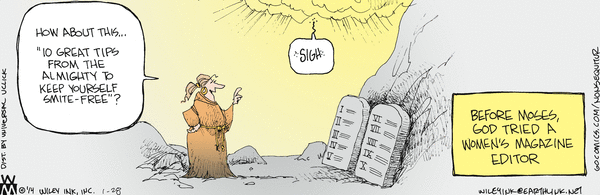 |
| NON SEQUITUR © Wiley Ink, Inc.. Dist. By UNIVERSAL UCLICK. Reprinted with permission. All rights reserved. |
That
had to sting. But the strip makes a
point that the cover content of women's magazines, carried over to their web
sites as well, reminds women that no matter how good they have it, there's
always something about them and their lives that needs fixing. For example:
5 Low Carb Sandwiches that Still Taste Good
100
Amazing Outfits for Every Day
8 Gorgeous Erotic Lesbian Line Drawings You'll
Want to Print Out and Color Immediately
19 Times Chrissy Teigen Nailed Her Look
With
all that listmaking, tip following, and idea implementing a reader would have
to do, there'd be no time to do much else with her life, and no guarantee that
the results would be what she hopes for.
With this tip mania, the magazines continue to promote an endless cycle
of self-improvement, with a message that is subtly negative and potentially
toxic to the self-esteem of women and girls who read them.
Tuesday, January 21, 2014
Where Are the Women? Press Club Panel Discusses How to Increase Sourcing, Commentary

With poor gender balance, "You're not going to get the full range of opinions," said panelist Sally Buzbee, Washington bureau chief for the Associated Press. "I remember vividly during the Iraq war, the challenges of being able to talk to Iraqi women, and how one-sided that made much of our coverage."
But even without war and cultural barriers as explanations, women don't appear much in domestic news, either, as numerous content analyses have shown -- even when the subject matter directly affects them.
This panel discussion didn't offer a magic solution to how to solve the problem, but instead offered a spirited conversation about what is possible, what is being done, and how women can assert themselves as sources, reporters and commentators to occupy more of the real estate on news and editorial pages. It's 107 minutes long and can be viewed here.
Monday, January 6, 2014
TV Sports Programming Keeps Revving Up Sexist, Sexual Ads
Brace yourselves for an onslaught of tastelessness come Super Bowl Sunday Feb. 2. If the Jan. 5 NFL playoffs were any indication of the sexist and sexual themes that are coming in TV commercials, this year's Super Bowl will be a doozy.
First, there was has-been NFL player Terrell Owens being dissed by fans but seduced by the pool by under-dressed, over-siliconed women. For mid-day on a Sunday, when this ad aired, the explicitly sexual behavior was a shocker. And what was TO selling? Besides his sexual prowess, that is? A hamburger from Hardees, which needs to hire a new ad agency if this is the best they can do. Watch it here.
 Then there was the mocking of motherhood by Old Spice body spray for men. Here the theme was moms who just can't let go of their darling boys, taken to ridiculous and actually somewhat sadistic extremes in this commercial. I don't know who would rush out and buy the product after seeing this commercial, but somebody ought to send flowers to Mom.
First, there was has-been NFL player Terrell Owens being dissed by fans but seduced by the pool by under-dressed, over-siliconed women. For mid-day on a Sunday, when this ad aired, the explicitly sexual behavior was a shocker. And what was TO selling? Besides his sexual prowess, that is? A hamburger from Hardees, which needs to hire a new ad agency if this is the best they can do. Watch it here.
Subscribe to:
Posts (Atom)